MALACHECK
An easy to use malaria rapid diagnostic test kit
00

Problem
How might we empower malaria patients to self-administer and interpret diagnostic tests with confidence, independent of clinical training, within a high-stress time-critical context to steer their own health outcomes toward a safer global response to Malaria?
Solution
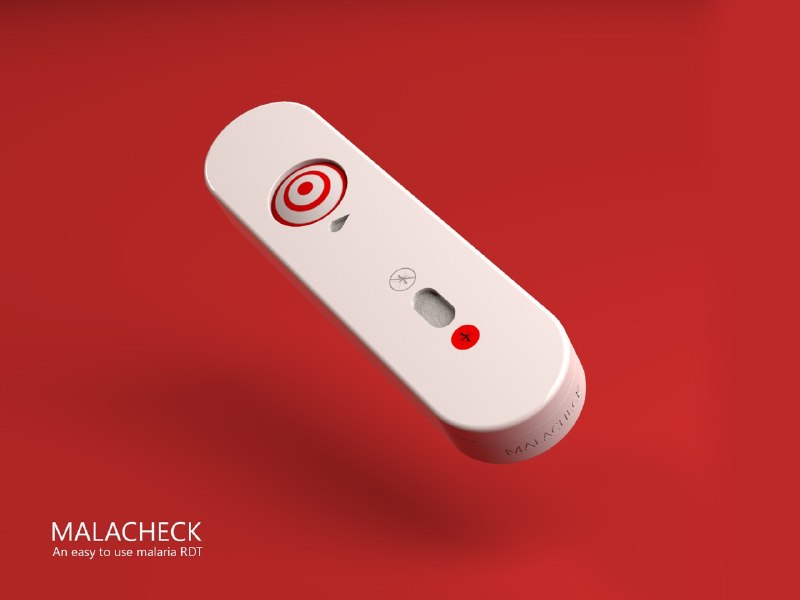
Malacheck reframes the failure of malaria rapid testing as a design problem rather than a behavioural one. By consolidating a fragmented, multi-tool process into a single guidance-integrated device, it reduces cognitive load at the most critical and vulnerable moment of care.
Story
This project began during COVID when our team asked a simple question: which diseases had the world stopped paying attention to?
My role was leading the research, defining the design principles, building the human-centered design framework, and directing the overall vision of the project.
Rather than jumping into solutions, I framed the project around three questions: Could design reduce diagnostic delay? Where in the malaria journey is the greatest leverage point? And ultimately, is this a product problem or a systems problem?
Four statistics stood out: over 600K deaths annually , 280 M cases per year, symptoms take10-15 days appear, the and the current rapid diagnostic test involves a 12 step complex process.
The data suggested that even small improvements could have global impact, that time is a critical variable, and that complexity might be one of the biggest barriers. This was a key turning point. Across the research, five themes emerged. 1) Symptoms are often dismissed 2) access to healthcare determines diagnosis 3) expertise is a major barrier 4) caregivers are often the true decision-makers 5) system bottlenecks delay treatment. These insights directly informed the design principles moving forward.
Several key intervention supported this goal: Multi-user ergonomic design, High-leverage, low-scope intervention, Speed and confidence as design goals, Guidance embedded in the device, Single unified form factor.
The final outcome reframed malaria testing as a design challenge rather than a behavioral challenge. Instead of asking users to adapt to complexity, the design absorbs that complexity into the product itself.
year
2020
timeframe
6 weeks
tools
Keyshot
category
Personal Project
01

02

03

see also